
 Jul 21, 2026
AIdesignTEX Summer School on Circular Economy in Textile Production Successfully Completed
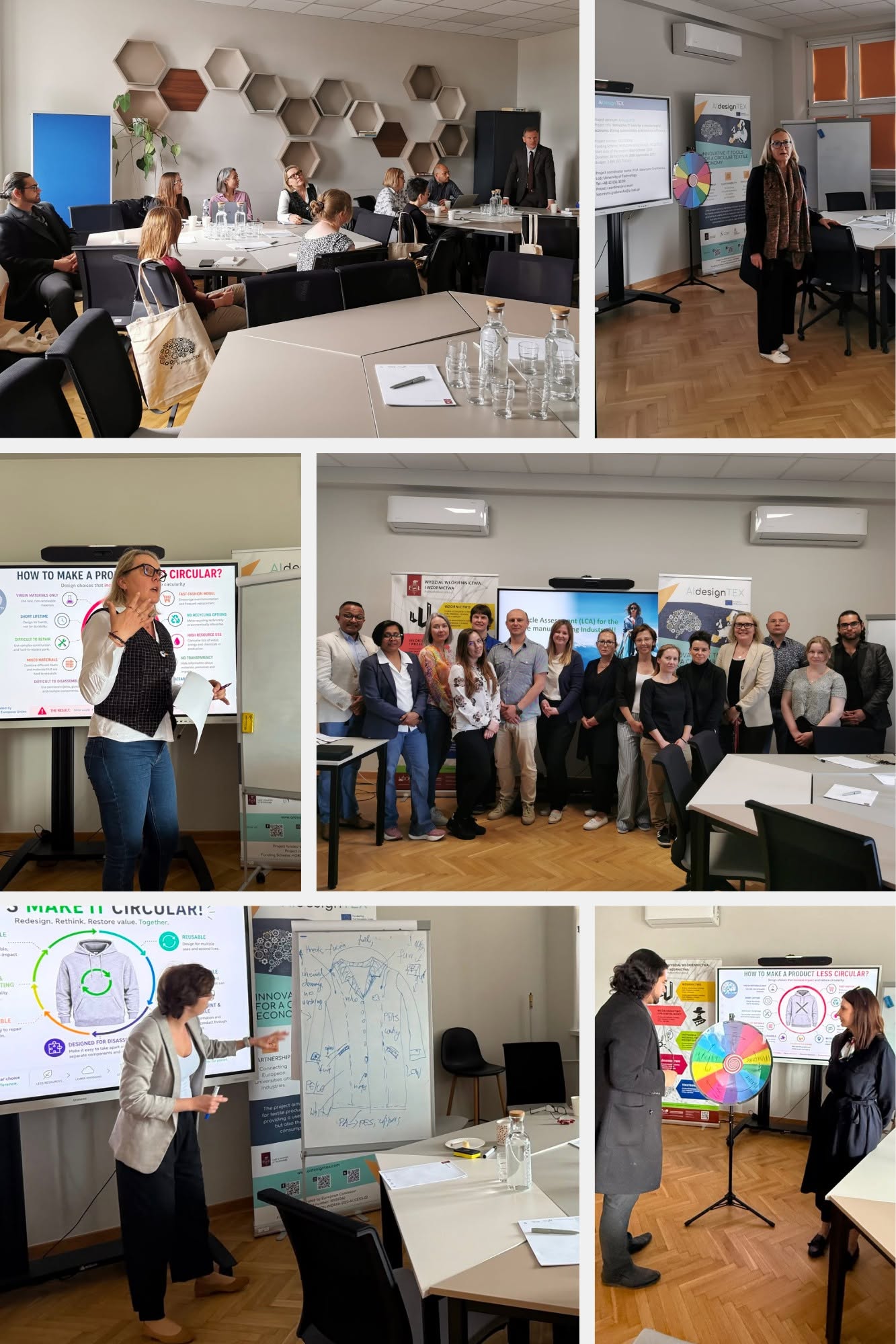
The AIdesignTEX Summer School "Circular Economy in Textile Production: Shifting Towards Sustainable and Regenerative Practices" has been successfully completed at Lodz University of Technology.
The five-day programme brought together participants from Lodz University of Technology, CIOP-PIB, Łukasiewicz – Lodz Institute of Technology, and the University of Humanities and Economics in Lodz. The Summer School created an interdisciplinary space for learning, discussion and reflection on the future of the textile and clothing sector in the context of sustainability, circular economy, digitalisation and responsible innovation.
The first day of the Summer School was led by Prof. Monika Malinowska-Olszowy and Dr. Anna Bacciarelli-Ulacha from Lodz University of Technology. The programme started with an introduction to the AIdesignTEX project and its objectives, followed by interactive activities focused on global inequalities, textile consumption and the environmental consequences of the current linear model of production and consumption. Participants discussed why the textile sector needs circular transformation and how product design decisions influence durability, repairability, reuse and recyclability.
An important part of the first day was the Global Village and Global Textile Village exercise, which helped participants reflect on the unequal distribution of population, resources, production and consumption across the world. This activity provided a starting point for a broader discussion on the global textile system, including the concentration of production in selected regions, the high level of consumption in wealthier economies, and the very limited scale of textile-to-textile recycling.
The following sessions focused on circular product design and ecodesign. Participants explored what makes a product circular and analysed which design decisions can make textile products difficult to repair, reuse or recycle. Practical group work encouraged participants to look critically at materials, product construction, business models and end-of-life scenarios.
On the second day, the Summer School hosted experts from the University of Stavanger: Prof. R.M. Chandima Ratnayake and Prof. Samindi Samarakoon. Their sessions focused on the role of Artificial Intelligence, data-driven decision-making and Life Cycle Assessment in supporting the circular transformation of textile and apparel manufacturing. Participants discussed how AI can help optimise production processes, reduce resource consumption, improve product durability, support material selection and enable circular design. The LCA session introduced participants to environmental assessment methods, ISO standards and the analysis of textile manufacturing processes from a life-cycle perspective.
A key reflection from the discussions was that AI should not be understood as a replacement for human expertise. Instead, it should be seen as a tool supporting designers, engineers, technologists and decision-makers. Its value lies in analysing complex data, comparing scenarios, identifying sustainability hotspots and supporting more resource-efficient and circular solutions.
During the Summer School, participants also discussed the main areas in textile production where AI can bring real value. These include material selection and product design, demand forecasting and overproduction reduction, production planning, resource efficiency, cutting optimisation, quality control, energy and water management, traceability, Digital Product Passport data, and textile waste sorting and recycling pathways.
Another important conclusion was that the transition towards a circular textile economy cannot be understood by looking only at production processes. A system-wide perspective is needed, covering the entire textile ecosystem: materials, design, manufacturing, business models, sales channels, consumer behaviour, supply chains, digital technologies, regulations and end-of-life management.
The final day of the Summer School was dedicated to reflection, discussion and creative expression. Participants took part in a painting workshop entitled "The Colours and Shapes of a Sustainable World". Through colours, forms and visual symbols, they expressed their own visions of a more sustainable and circular future. This creative activity provided a space to summarise the ideas discussed during the week and to reflect on the emotional, social and environmental dimensions of sustainability.
The Summer School concluded with a final discussion and evaluation session. Participants reflected on how the knowledge gained during the programme could be applied in research, education, industry and everyday decision-making.
The AIdesignTEX Summer School demonstrated that the circular transformation of the textile sector requires cooperation between science, industry, policy-makers and consumers. It also showed that responsible innovation, digital technologies, Artificial Intelligence and creative thinking can play an important role in building a more circular, sustainable and resilient textile ecosystem.
We would like to thank all participants, speakers and partner institutions for their active involvement, valuable contributions and inspiring discussions throughout the five-day programme.
"Funded by the European Union. Views and opinions expressed are however those of the author(s) only and do not necessarily reflect those of the European Union. Neither the European Union nor the granting authority can be held responsible for them. "
If you enjoyed the content please share it on LinkedIn:


